Commentary /

Digital Competition Conference 2026: The Next Phase of Competition in Digital Markets

This year’s Digital Competition Conference brought together researchers, policymakers, businesses, litigators, and civil society experts from over 37 countries to explore the latest lessons, challenges, and opportunities in regulating and enforcing competition in digital markets.

Promoting competition in digital markets has become a priority for certain policymakers around the world. From app store regulation and use of publisher content for AI to implementation of the European Union’s (EU’s) Digital Markets Act (DMA) and various antitrust cases in the United States, digital competition policy now sits at the center of global headlines. This sustained attention and action raises pressing questions about regulatory design and implementation that can only be answered with interdisciplinary insights spanning computer science, economics, and the law. Against this backdrop, the Digital Competition Conference 2026 convened experts and practitioners to explore the latest challenges and opportunities in regulating and enforcing competition in digital markets.

Organized by the Knight-Georgetown Institute (KGI), the Yale Tobin Center for Economic Policy’s Digital Economy project, and the Princeton Center for Information Technology Policy, DCC ‘26 brought together cutting-edge academic research and real-world enforcement experience. The conversations at DCC ‘26 highlighted how scholarship and policy practice are interdependent: research helps clarify sources of power and theories of harm, while enforcement challenges surface new questions for rigorous analysis.

Hosted in Washington, D.C. and online, and drawing participants from 37 countries, the DCC ‘26 underscored the importance of cross-jurisdictional learning as policymakers adopt different approaches to navigating shared challenges in digital markets. We’ve summarized some highlights below; those looking to dive deeper can find session recordings, slides, and papers here

Enabling Competition in App Stores

Keynote remarks by Julian Wright (National University of Singapore) at the Digital Competition Conference 2026.

Julian Wright, Professor of Economics at the National University of Singapore, kicked off the conference with a keynote address showing how economic theory supports interventions designed to facilitate app store competition, and the guardrails that should be in place for competition to deliver benefits to consumers. 

Lawmakers and courts across the EU, UK, US, Japan, Australia, Canada, and Brazil are considering or imposing changes on the two app stores that dominate mobile operating systems, Apple’s App Store and Google Play. App stores are characterized by high commissions and restrictions on third-party app stores and alternative payment processors for in-app purchases.

Wright explained how Apple and Google exploit a “competitive bottleneck” in app distribution. Consumers typically use a single mobile operating system—iOS or Android—giving mobile platforms monopoly-like power over developers who need to reach those consumers. Economic theory shows that this leads to excessive commission fees, self-preferencing, and anti-steering measures. The problem is compounded because platforms are complements for developers, meaning high commissions by one platform also harm the other, creating additional pressure toward excessive fees across the board.

Wright showed how enabling genuine competition in app distribution markets – by allowing alternative app stores, direct downloads from the web, developer steering, and alternative payment solutions – could change these dynamics. Write cited existing game marketplaces like the Epic Games Store as examples to show how this can work in practice. For competition to succeed, however, policymakers must prevent dominant mobile operating systems from taxing or degrading third-party app stores through price squeezes, exclusivity requirements, discrimination, tying, or friction-inducing “scare screens.”

AI Antitrust Theory of Harm

Interactive session by Jonathan Kanter (Carnegie Mellon & Washington University in St. Louis) at the Digital Competition Conference 2026.

Jonathan Kanter, former head of the Antitrust Division at the US Department of Justice, led an interactive session with the audience on AI theories of antitrust harm. He urged courts and enforcers to adapt their analytical tools to address durable power in digital markets and efforts to stifle competition in AI.

Kanter argued that monopolization law is more flexible and robust than some defendants claim. Drawing on three recent circuit court decisions in which the DOJ strategically engaged, he pushed back against narrow readings of Trinko that would effectively immunize refusals to deal. He pointed to the recent Duke Energy case as particularly salient, showing that individually lawful acts can together constitute an unlawful scheme when bound by a common anticompetitive plan.

Working together with the audience, Kanter demonstrated that rather than mechanically defining markets and tallying conduct types, serious practitioners should start by identifying the source and durability of market power, understanding the underlying economics, mapping the competitive threats a dominant firm faces, and then examining what actions it took to neutralize those threats. Attendees discussed how control over vast datasets, dominance of distribution channels, and exclusive access to specialized chips can combine to confer substantial advantages on leading companies like Google. Throughout the session, Kanter’s central warning was that competition authorities should not assume that the emergence of AI will dissipate concentrated economic power, nor that such power will fail to emerge.

Content, AI, and Antitrust

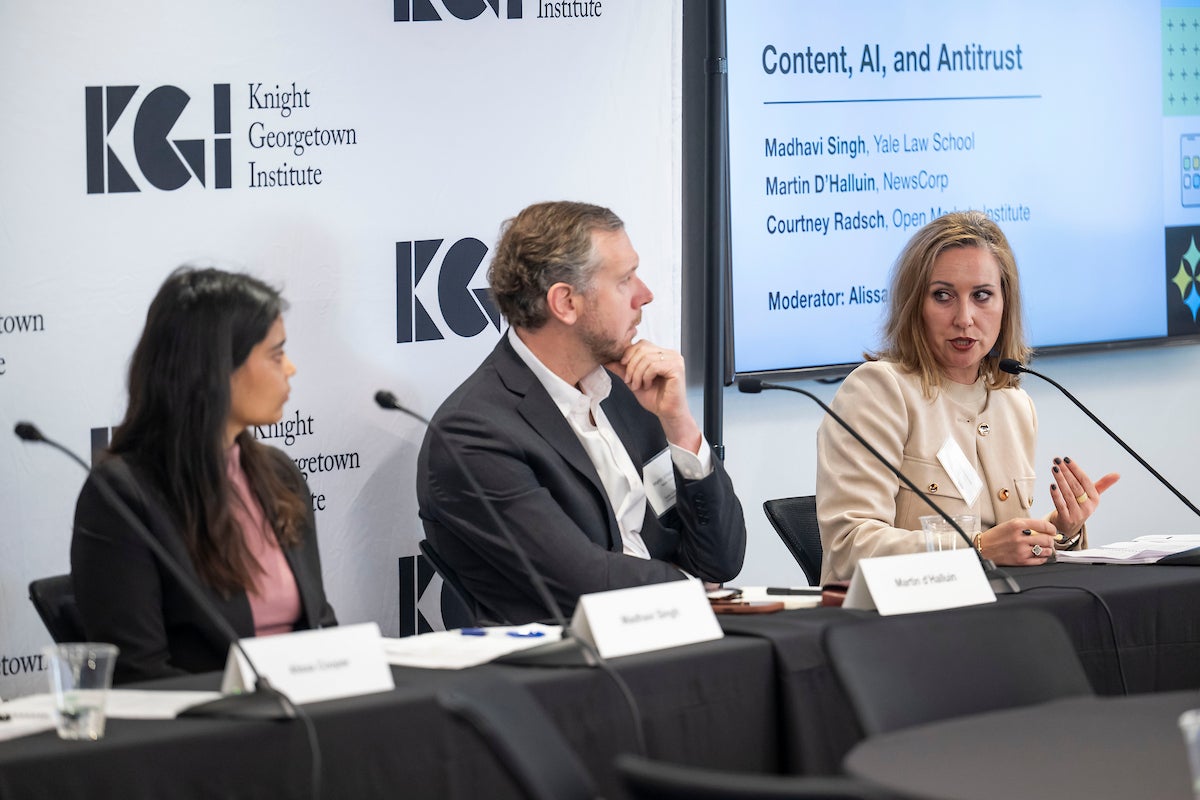
Madhavi Singh (Yale Law School), Martin D’Mallunin (NewsCorp), and Courtney Radsch (Open Markets Institute) during the “Content, AI, and Antitrust” panel.

Madhavi Singh, Martin D’Mallunin, and Courtney Radsch examined how durable sources of power like control over data and distribution channels in online search may undermine the sustainability of content markets and the open web. The discussion centered on how Google’s dominance in search shapes bargaining dynamics with publishers.

Panelists described how generative AI tools like Google’s AI Overviews reduce the likelihood that users will click through to original sources. Indeed, evidence suggests that crawling for AI summaries and other AI products results in less referral traffic for publishers than traditional search. Panelists also emphasized that appropriation of publisher content may accelerate the decline and exit of publishers from content markets and contribute to the replacement of journalists.

The discussion underscored uncertainty surrounding remedies for these harms. Some proposals focus on fostering greater competition, such as by enabling index sharing, while others emphasize transparency and greater control over how content is used by AI companies. Yet significant technical and practical challenges remain. Panelists agreed that additional research is urgently needed to inform policy design, including clearer avenues for monetization, governance blueprints drawn from other industries like music, and a deeper understanding of how AI summaries affect consumer behavior. 

Competition, Privacy, and Security

Daji Landis (New York University) giving a presentation during the “Competition, Privacy, and Security” panel.

A major theme of the conference was the complex relationship between promoting competition and protecting privacy and security in digital markets. The DCC featured research talks on this relationship from Daji Landis, Joseph Jerome, Yifei Wang, and Thijmen van Gend.

Daji Landis spoke on how dominant companies frequently invoke privacy and security risks when resisting pro-competition reforms. While some risks are genuine, Landis emphasized the need to distinguish clearly between bona fide engineering constraints and privacy pretexts. Joseph Jerome presented a concrete proposal for how to work through this tension in practice, describing a system whereby Google could share search query data with competitors while combining several privacy preservation techniques: targeted filtering of personal data, metadata generalization (to remove precise user location, for example), and elimination of unique queries.

Yifei Wang and Thijmen van Gend’s talks examined the broader relationship between competition and data extraction. Wang presented a study of the Chinese app market following censorship of foreign apps, which found that declines in competition were associated with more privacy intrusion. The banned foreign apps had historically requested fewer permissions from users than many domestic counterparts. Their removal likely reduced incentives for remaining companies to compete on privacy. van Gend described how Amazon’s deployment of privacy-enhancing technologies (PETs) paradoxically helped to entrench the position of its cloud services. Amazon Sidewalk enables Echo and Ring devices to connect with Internet of Things devices, and the company uses PETs in the design of Sidewalk to protect privacy while also forcing developers to use Amazon’s cloud services.

Learning Across Jurisdiction

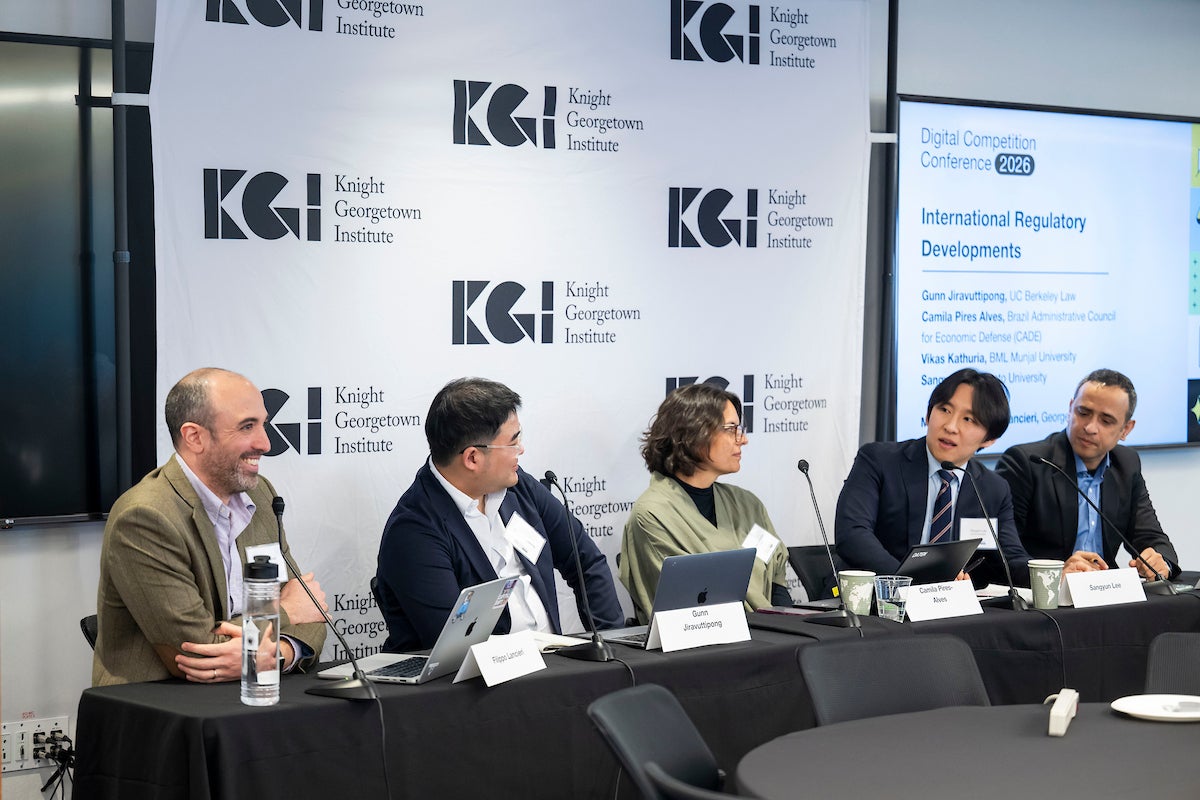
Gunn Jiravuttipong (UC Berkeley Law), Camila Pires Alves (Brazil Administrative Council for Economic Defense –CADE), Vikas Kathuria (BML Munjal University), Sangyun Lee (Kyoto University), and Filippo Lancieri (Georgetown Law) during the “International Regulatory Developments” panel.

DCC ‘26 showcased the importance of learning across jurisdictions as countries experiment with new approaches to promoting competition. Participants emphasized how regulatory frameworks work in practice abroad and how many jurisdictions are adapting these foreign models to reflect their own local contexts and priorities.

One panel discussion centered on lessons from the institutional design of the DMA. Jérémie Jourdan contrasted the swift speed of DMA enforcement with the slow pace of traditional competition law, highlighting examples like the European Commission’s 2025 DMA specification proceedings related to Apple’s interoperability obligations. Alexandre de Streel and Felix Styma framed the first two years of DMA enforcement as a learning experience for the Commission and called for more guidance and quantitative indicators of regulatory success. The panelists agreed that DMA enforcement has not been dissuaded by recent pushback from the Trump Administration, but that these headwinds raise long-term concerns about European dependence on US technology.

The DMA’s implementation is part of a broader, global response to shared competition problems in digital markets. Experts from Brazil, India, and South Korea discussed how their jurisdictions are crafting their own digital competition laws. Camila Pires Alves described how Brazil’s proposed law is partially modeled after the DMA in order to prioritize certain markets and accelerate the pace of enforcement. Vikas Kathuria delved into the process of crafting India’s expert report on digital competition, which featured stark divisions between large platforms and representatives of startups. And Sanyun Lee discussed how efforts to pass digital competition laws in South Korea failed to overcome resistance from the US government and Korean technology companies. 

As a whole, these developments reflect an emerging shift from ex post, case-by-case antitrust enforcement toward bespoke regulatory regimes designed to proactively shape platform governance.

Looking Ahead

Across these discussions, one message was clear: the stakes are higher than ever for digital competition policy. The DCC has become the premier venue for research-to-policy conversations in Washington, and we look forward to continuing the conversation in the year ahead.

Close