Business Models
Key Insight #4: Innovation in feed design appears most promising on platforms with business models that differ from traditional pay-per-impression or pay-per-click advertising. On ad-based platforms, the use of Key Performance Indicators (KPIs) often reinforces optimization for engagement. These are specific, measurable metrics that companies use to track progress and evaluate employee success. When employee KPIs, and the promotions or bonuses tied to them, are directly linked to growth in user engagement, the business model naturally incentivizes algorithms that prioritize capturing short-term attention, as this is what both the company and its employees are rewarded for. Conversely, platforms with alternative business models often have different incentives, where a different concept of “stickiness” or product value may be inspiring more focus on long-term value or satisfaction.
- Subscription Models: Platforms like LinkedIn and Hinge engage in advertising but also rely on some users paying a fee. For them, success is not just about engagement and attention, but about providing enough sustained value that a user is willing to continue paying for the service. The long-term user value of these platforms is easy to identify: for LinkedIn, it’s career advancement, and for Hinge, the “dating app designed to be deleted,” it’s finding a lasting relationship. Both represent clear, tangible goals that users value enough to pay for, aligning the platform’s financial success with the user’s real-world success.
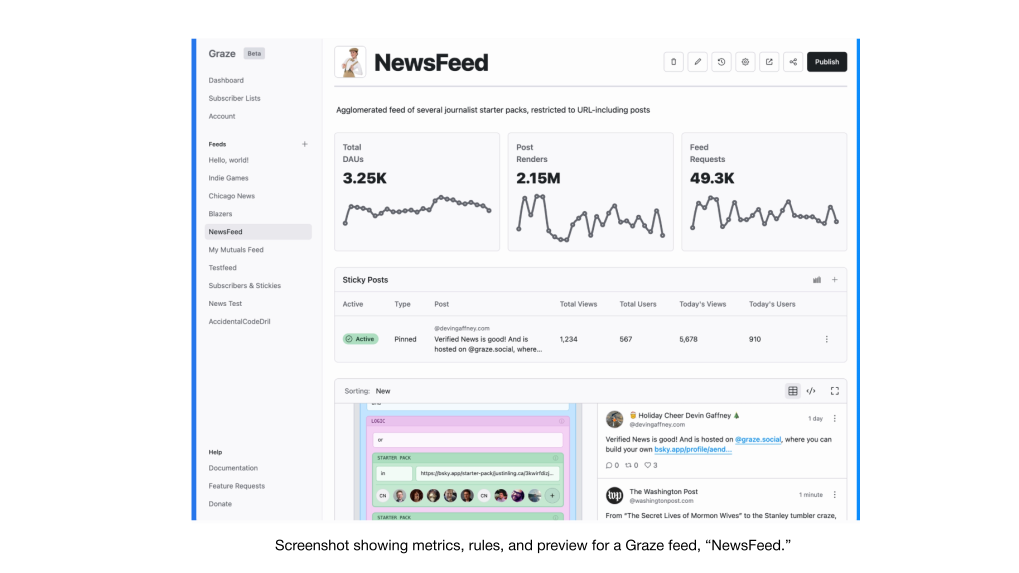
- Nontraditional Advertising: Other platforms and tools are integrating advertising in nontraditional ways. The platform WeAre8, a b-corporation, short-form video and text platform built around social and environmental good, shares a percentage of ad revenue with users and with charities. This explicitly recognizes the economic value that users’ attention brings to the platform. Graze Social has created a marketplace that feed curators can use to sell and include sponsored content on their feeds. If a curated feed loses the trust and interest of its audience by including too many or irrelevant ads, followers can easily stop following the specific feed without losing access to the platform the feeds are displayed on.
Experimentation
To predict and understand the impact of changes before making business decisions, platforms rely on experimentation. A primary method is A/B testing, where different user groups are shown distinct versions of a product to compare performance—for example, testing a blue button against a green one. A specific experimental technique involves a holdout group, where a set of users (“holdouts”) is intentionally excluded from new features to serve as a pure baseline. Long-term holdouts are experiments where the holdout user group does not receive changes for twelve months or more, a necessary practice for understanding the changes’ true effects on long-term value.
The effects of platform changes on long-term satisfaction can often look like failures in the short run. A feature that reduces annoying notifications might cause daily active minutes to dip initially, leading a product team to discard it. However, over months, that same change could lead to higher overall user satisfaction and better retention. Long-term holdouts provide a stable baseline to measure these cumulative effects, preventing platforms from misinterpreting a short-term dip in engagement as a long-term loss of value.
Key Insight #5: Long-term holdouts are much less common than short-term holdouts. A single platform may run thousands of short-term A/B tests in a year, but most do not run holdouts that are longer than a business quarter, let alone a year.
Key Insight #6: Large holdouts can be challenging for small platforms, and there is a limit on the number of meaningful holdout experiments that can coexist on any platform at the same time. For a smaller service, dedicating a statistically significant portion of its limited user base to a holdout represents a high opportunity cost, slowing down its ability to test new features needed for growth.
Industry research reveals a sophisticated conversation happening around the challenge of measuring true, long-term product value. A core problem is that short-term engagement metrics, which are easy to measure in standard A/B tests, are often poor indicators of long-term user satisfaction and retention. Undesirable features can sometimes increase short-term engagement even as they degrade the user experience.
To address this, platforms are developing surrogate or proxy metrics. These are short-term, measurable indicators chosen for their strong correlation with a desired long-term outcome. For example, Pinterest uses in-app user surveys to directly measure qualities like “inspiration” and “personal relevance,” creating a proxy for long-term value. However, proxy metrics can prove to be complex, requiring robust statistical modeling to validate the proxy and accounting for biases, such as the tendency for the measured positive effects of “winning” experiments to be overestimated due to error margins.2 Methods like meta-analysis of many experiments and experiment splitting can be used for more accurate measures of impact. A meta-analysis statistically combines the results from numerous individual experiments to estimate an overall effect with greater confidence. Experiment splitting helps correct for bias by using one portion of the experiment’s data to select the “winning” version and a separate, second portion to measure its true performance.
Ultimately, even with better statistical tools, defining and measuring long-term value remains a challenge. It requires a commitment to running long-term holdouts to validate that decisions based on proxy metrics are actually delivering the intended benefit. It also requires a willingness to push back against the assumption that engagement (short-term or long-term) is a suitable proxy for user value.
Conclusion
While engagement-driven feeds and limited user controls remain a dominant algorithm model across major online platforms, this is not the only path forward. Emerging approaches across algorithmic design, user choices and controls, business models, and experimentation demonstrate that it is possible to build algorithms that prioritize long-term user value over short-term engagement and attention maximization.
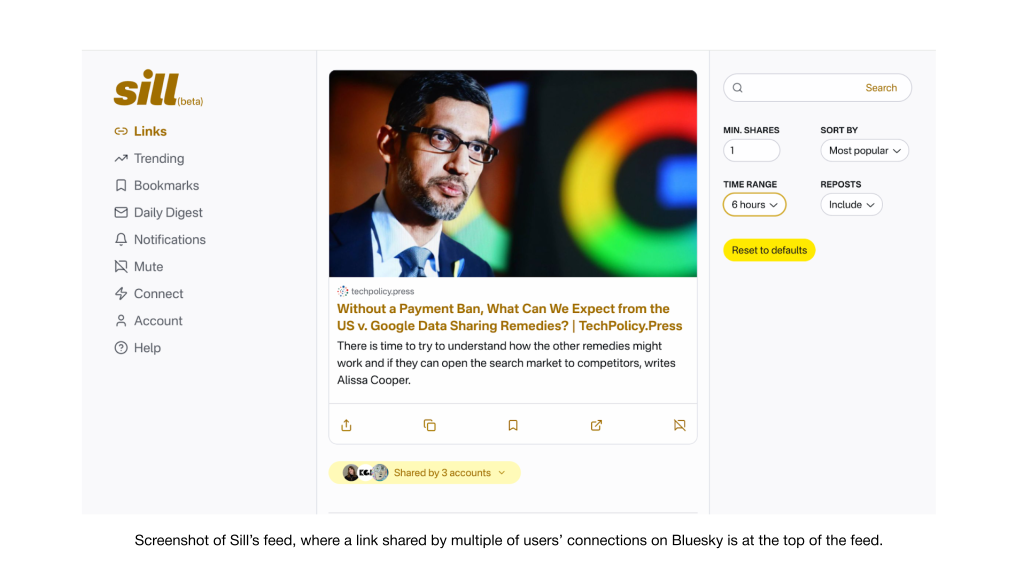
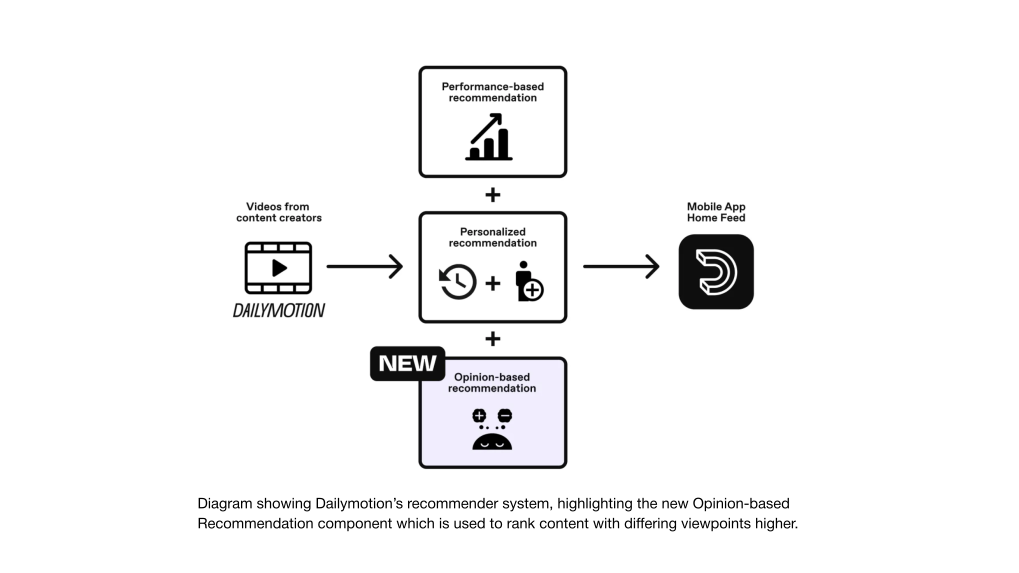
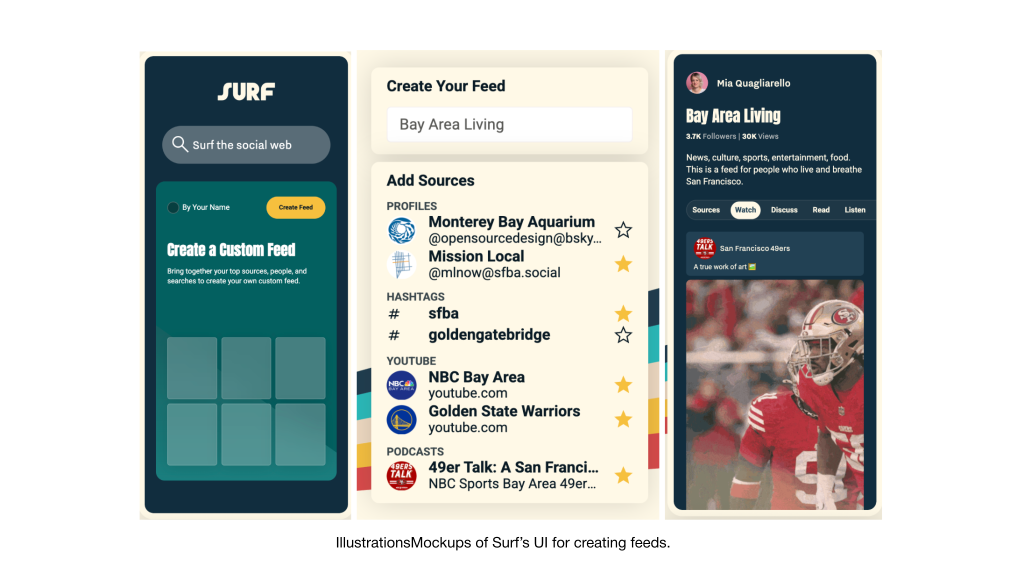
From quality- and bridging-based feeds like Sill and Dailymotion, to custom feed creation tools from Graze Social and SkyFeed, subscription-aligned incentives on LinkedIn and Hinge, and user surveys on Pinterest measuring “inspiration” and “personal relevance” as proxies for long-term value, these innovations demonstrate that healthier, people-centered feeds are possible and that platforms can design systems that put users first.